Is Cereal a Soup?
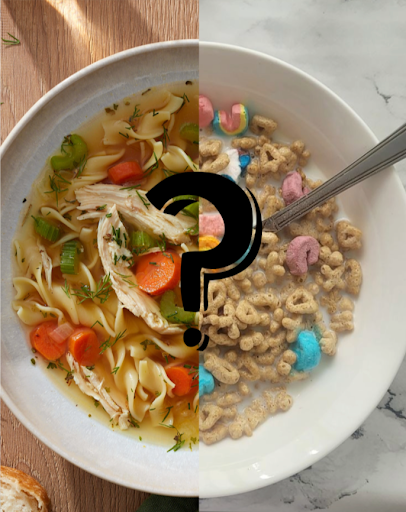
The question of whether cereal qualifies as soup seems trivial, yet it reveals how definitions can shape the way in which people categorize everyday experiences. While cereal and soup are culturally treated as two completely different foods, closer analyses of their structure, preparation, and purpose suggest that cereal can reasonably be classified as a form of soup.
At its most basic level, soup is a dish consisting of solid ingredients submerged in a liquid; this definition does not include heat, savory flavor, or specific ingredients. Under this broad framework, cereal fits the criteria: it combines solid components (the cereal) with a liquid (typically milk). Like soup, cereal is assembled by placing solids into a liquid base, creating a mixture consumed together rather than separately.
Additionally, the preparation method of cereal mirrors that of many soups. Both involve minimal cooking, or none at all in certain cases. For example, cold soups, such as gazpacho, challenge the assumption that soup must be hot, just as cereal challenges the idea that soup must be savory. If temperature and flavor are not essential requirements, then cereal cannot be excluded from the category of ‘soup’ based on physical components.
Alternatively, despite these clear shared qualities, cereal fundamentally differs in purpose and cultural meaning. Soup is generally associated with meals like lunch or dinner and often serves as a main or starter dish, while cereal is typically considered a breakfast food or snack. This distinction, though, reflects social conventions rather than adhering to the formal definition of what makes soup ‘soup’.
Ultimately, whether cereal is considered a soup depends on whether one prioritizes structural definitions or cultural norms. From a structural perspective, cereal meets the basic criteria of a soup: solids in a liquid, consumed together. From a cultural perspective, it remains distinct due to tradition and expectation. Therefore, while it may feel unconventional to label cereal as soup, the debate reveals that the categories which people rely on are shaped less by objective rules than by shared colloquial assumptions.